Short answer
Endacopia meaning is not given a single official definition in the collected developer, Steam, or ending material. The strongest community readings split the title into parts associated with endings, marriage, copying, or an inability to cope with an end, but those proposals conflict and remain interpretation. The game itself more securely supports themes of guidance, repetition, constructed spaces, memory, and Mellow choosing whether to leave, return, or stay.
The four recorded outcomes are Escape, Return, Stay, and The Yeti, with the first three functioning as the main ending routes and the last as a later hidden sequence. Escape uses the Toy Saw, Return uses the real Saw, and Stay requires one optional secret in each Chapter I area before Mellow returns to his room during the Chapter III epilogue. Those trigger conditions are confirmed events and should not be confused with what a player thinks the endings symbolize.
No approved source checked for this page declares one ending to be the only canon conclusion or provides an official etymology for the title. A public post in the research asks Andyland what the name means but contains no captured developer answer. The exact intended word origin is therefore To be confirmed, while thematic analysis can still be useful when it is presented as a reading rather than a hidden fact.
Confirmed story and ending events
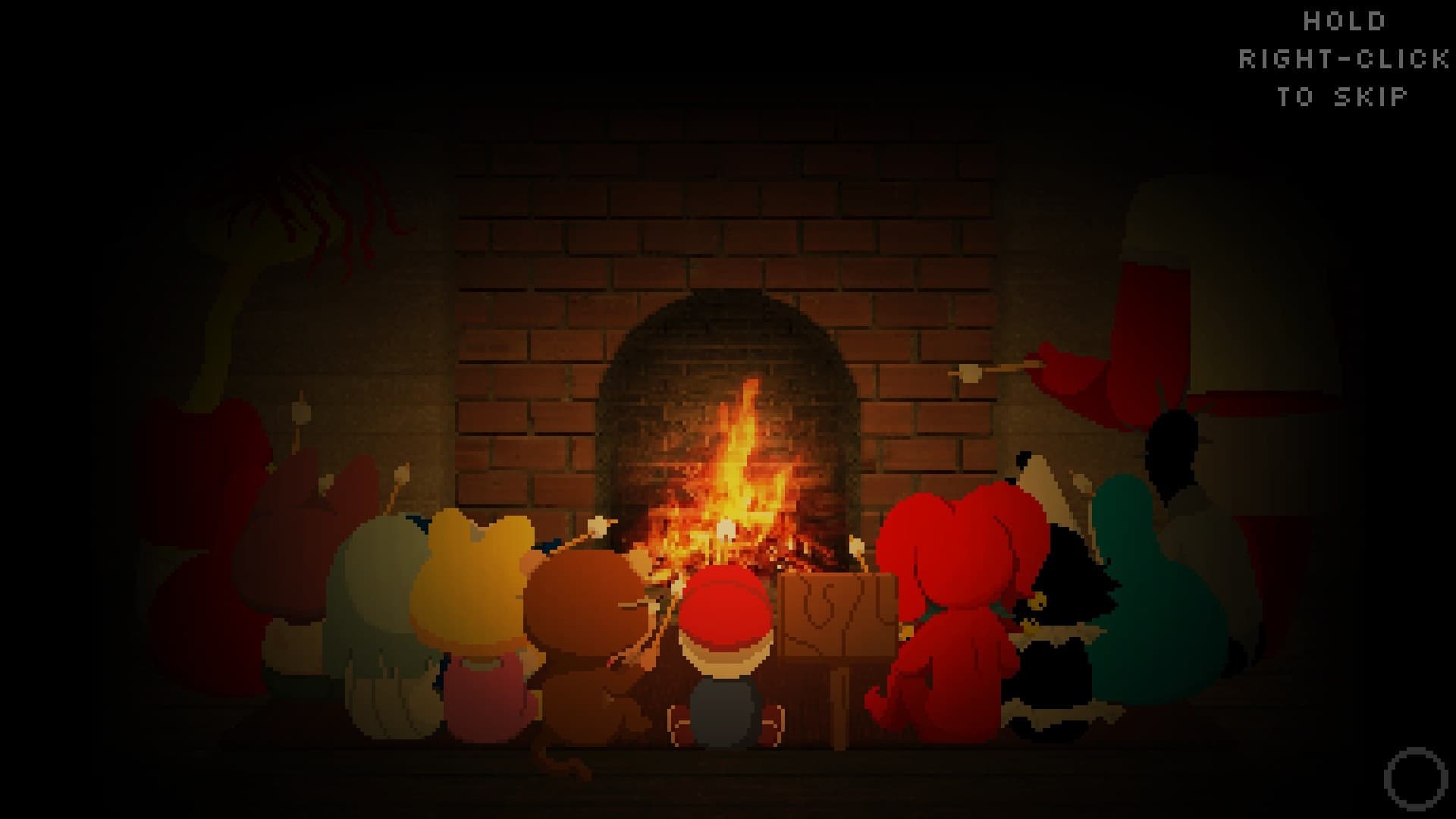
Mellow begins inside the House with limited memory and recognizes the player as a guardian angel who helps him observe, move, speak, use items, and survive combat. The House contains familiar childhood objects beside impossible residents, shifting rooms, and access behind walls. This establishes the boundary between Mellow's world and the guiding player, but it does not formally explain who created that boundary.
Chapter I spreads optional work across Misery Town, Timesville, and the Office, and those secrets must be completed on the same restored route for Stay. The Misery route uses the detector, projector remote, and hidden map, while Timesville uses the fish reward key and window sequence. The Office route uses the telescope, a generated number, telephone interaction, Morse instruction, and logic rooms before the later epilogue trigger.
Escape and Return branch from the saw used with Roger in the later chapter, making the apparent exit change according to the chosen tool. Stay is prepared much earlier and is activated when Mellow refuses the obvious epilogue door and walks back to his room. The later Clocky encounter and window sequence make the accumulated hidden work visible, but the first Clocky fight does not require a special skip.
The Yeti is recorded as a hidden Steam achievement after the main outcomes and the Andy sequence. It works as a post-completion coda because the player reaches it with knowledge of the other endings, but Steam does not label it the only true ending. Any stronger claim about canon, authorship, or the literal identity of Andy must therefore remain To be confirmed.
How to interpret the name and endings
Begin with what the game demonstrably repeats: doors, windows, screens, rooms, observers, guidance, and the choice to cross or refuse a boundary. Mellow is inside the constructed space, while the guardian angel provides inputs from outside his immediate perspective. This supports a reading about agency and control, although it does not prove that every object is a literal computer metaphor.
Next compare Escape and Return from the same late Chapter I backup so the changed saw is the clearest major variable. Ask how each outcome frames leaving, rescue, identity, and the apparent destination without assuming that a different final image automatically marks good or bad. The game names the achievements Escape and Return, but moral rankings assigned by players remain interpretation.
Then compare Stay after completing all three area secrets, because that route rewards refusing the obvious exit and revisiting the place where Mellow began. The route turns curiosity and optional investigation into an ending condition rather than a collectible score. A reasonable reading is that remaining allows Mellow and the player to confront the world's structure, but the game does not issue a direct statement that staying is universally correct.
Finally place The Yeti after the three main outcomes instead of using it to erase them. Its position invites commentary on completion, Andy, and the relationship between game, creator, player, and character, yet the exact metaphysical explanation remains open. A careful interpretation names the visible event first, explains the proposed connection second, and labels any unsupported leap To be confirmed.
Name theories and common interpretation errors
One community theory divides the title into a form associated with marriage and a form associated with copying or doubling, then connects those ideas to the Bride and the Surgeon's composite work. Another response reads it as end plus a form of not coping with the end. Because these proposals use different word roots and the captured material contains no developer confirmation, both are theories and the official etymology remains To be confirmed.
A separate comment claims that Enda can mean freedom, which could appear relevant to Escape, but the research provides no linguistic source or Andyland statement connecting that word to the title. The idea should not be presented as translation fact merely because it fits one route. This page records that multiple readings exist and declines to choose a winner without stronger evidence.
Another common error is treating every hidden achievement as proof that one interpretation is canon. Achievements verify that a route exists and that a condition was met, but their names do not resolve every identity, relationship, or world-building question. Stay and The Yeti add context, yet neither Steam description supplies a complete lore explanation.
The final error is importing demo-era predictions or community biographies into the full game without checking changed context. Pre-release pages captured old dates, estimated lengths, unfinished character lists, and theories written before the July 2026 ending footage existed. A current interpretation should privilege released-game events and keep surviving demo details only when they remain reproducible.
Evidence boundary and current conclusion
Ending triggers were checked against Steam achievements, approved all-endings footage, and the existing route guides on this site. Those sources support the tools, three-area secret requirement, epilogue return, Clocky rematch, and post-completion sequence. They do not provide an official dictionary entry for Endacopia or declare a single canon route.
Community discussions are useful for identifying questions and possible readings, but their claims are not promoted automatically into the public source registry. The research included ads, unrelated recommendations, short reactions, and unsupported statements alongside the name theories. Those elements were filtered out, and the remaining theories are paraphrased as interpretation rather than quoted as authoritative lore.
The current conclusion is therefore deliberately limited: Endacopia's confirmed story is about Mellow being guided through a strange constructed world toward several choices about leaving and remaining. The title plausibly reinforces the game's concern with endings, coping, duplication, bonds, or freedom, but the intended derivation is To be confirmed. This boundary preserves the value of analysis without inventing a developer answer that the collected evidence does not contain.